ABSI and BMI Calculator
Calculate A Body Shape Index and BMI using height, weight and waist size. See the original formula, a worked example and what ABSI can tell you.
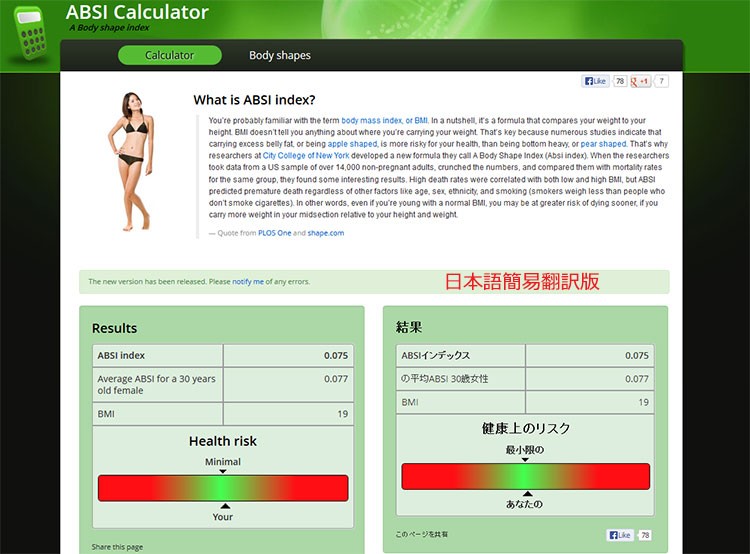
What does ABSI measure?
A Body Shape Index (ABSI) expresses waist circumference relative to height and BMI. The original research used data from 14,105 nonpregnant US adults. ABSI was associated with mortality after accounting for BMI and other factors. That population-level finding cannot predict an individual’s lifespan or diagnose a condition. (Krakauer & Krakauer, PLOS ONE, 2012)
How to calculate ABSI and BMI
BMI = weight (kg) ÷ height (m)²
ABSI = waist (m) ÷ [BMI^(2/3) × height (m)^(1/2)]
The calculator converts centimeters to meters before using the research formula. The units of ABSI are m^(11/6)·kg^(-2/3). At 170 cm, 65 kg and an 80 cm waist, the results are about 22.49 for BMI and 0.07701 for ABSI. (Krakauer & Krakauer, PLOS ONE, 2012)
Where to measure your waist
In the US survey used by the researchers, waist circumference was taken at the top of the hip bone. Use a consistent measurement site when comparing readings. The study also standardized ABSI by age and sex. This calculator displays the raw value. (Krakauer & Krakauer, PLOS ONE, 2012)
Frequently asked questions
Is 0.0787 an ABSI cutoff?
The study did not establish 0.0787 as a diagnostic cutoff. It interpreted values against age- and sex-specific reference data. (Krakauer & Krakauer, PLOS ONE, 2012)
What is the difference between BMI and ABSI?
BMI uses height and weight. ABSI adds waist circumference and adjusts it for height and BMI. (Krakauer & Krakauer, PLOS ONE, 2012)